
Roger Küng
Head of Operations EnergyCuringRAHN AG

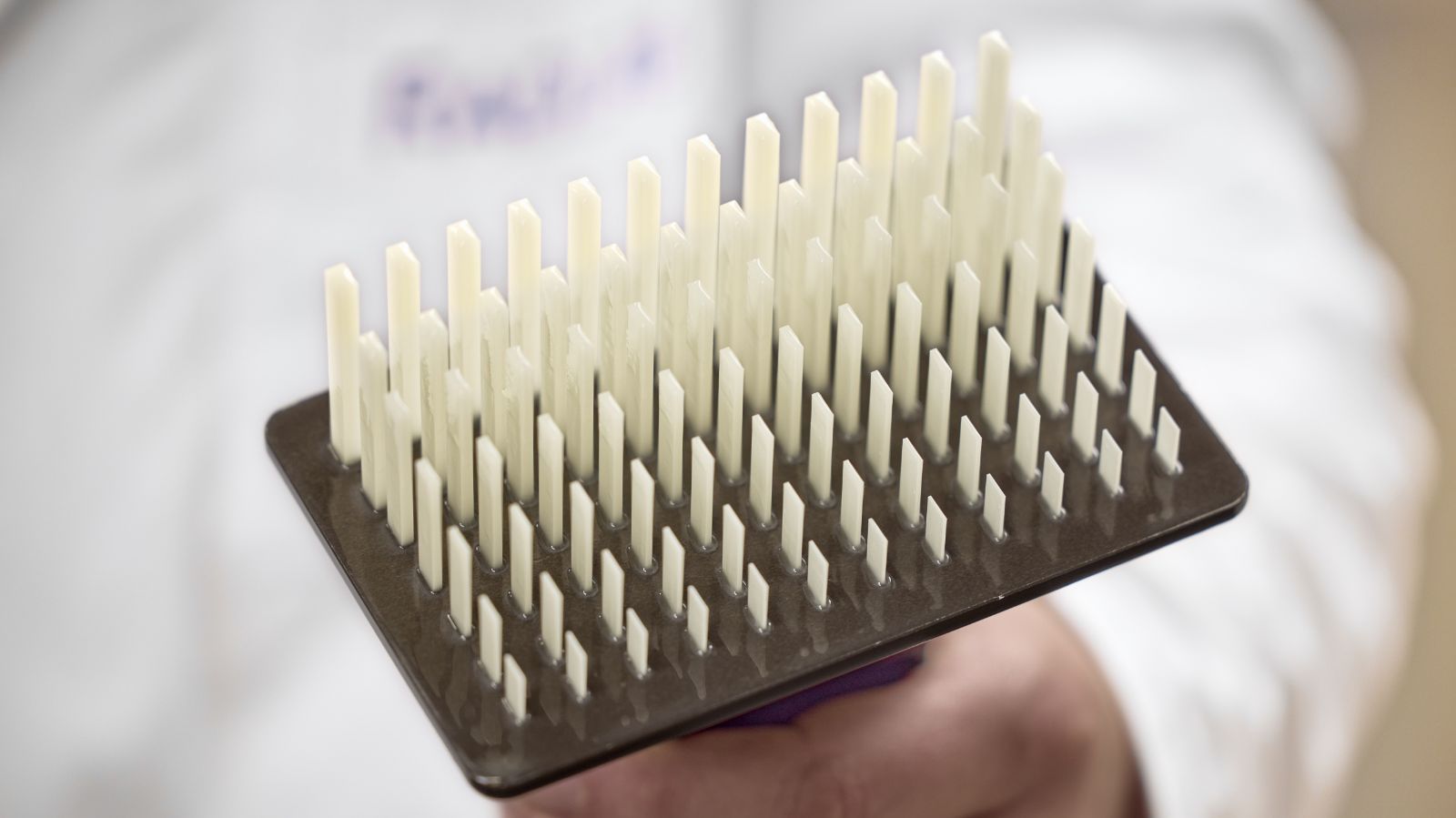
3D printing shrinkage is a hidden performance killer that affects accuracy, reliability, and production efficiency. When printed parts cool or cure unevenly, they contract and cause dimensional errors. Understanding shrinkage, and how to control it, is essential for achieving consistent, high-precision results in both prototyping and scaled manufacturing. Find out how to avoid 3D printing shrinkage by using low shrinkage 3D resin, optimal temperatures, supports and more.
3D printing shrinkage is the reduction in size that occurs when printed materials cool, solidify, or cure. Every polymer contracts as it transitions from a molten or liquid state to a solid state, which means that the final dimensions may differ from the digital model. This dimensional change can be calculated to improve accuracy.
Example: If you design a cylindrical part with a diameter of 50 mm but the printed result measures 47.5 mm, the shrinkage value is:
Entering this percentage into your slicer’s shrinkage compensation settings will scale future models slightly larger so they print at the correct dimensions. Once the updated value is applied, make sure to save the profile so your adjustments remain active for all subsequent prints.
Unchecked shrinkage creates a cascade of problems that quietly drain resources and slow production. Businesses often underestimate these losses until they accumulate into missed deadlines, material waste, and dissatisfied clients. Every reprint consumes more filament or resin, increases labour time, and forces engineers to adjust designs repeatedly. In competitive manufacturing environments, shrinkage-related delays can jeopardize contracts and increase operational costs.
| Cost Category | Impact |
| Scrap & reprints | Wasted materials, time, labour |
| Production delays | Slower development, missed deadlines |
| Quality failures | More QC work, rejected parts |
| Engineering overhead | Redesigns, scaling, compensation |
| Equipment investments | Heaters, enclosures, industrial machines |
| Client issues | Returns, dissatisfaction, contract penalties |
| Process errors | Failed jigs, fixtures, assembly misfits |
SLA 3D printing (stereolithography) benefits from a fundamentally different curing process. Instead of relying on heated extrusion and thermal cooling, SLA uses photopolymerization, which results in more predictable behaviour and tighter tolerances.
The main cause of shrinkage in 3D printing is the contraction of the material as it solidifies. This contraction occurs for different reasons depending on the printing technology:
Shrinkage may appear immediately after printing, but it often becomes more visible during post curing where the conversion of the system increased to its limit. It means when additional crosslinking increases the total polymerization shrinkage.
The example below shows the difference between a low shrinkage monomer and a higher shrinkage monomer.
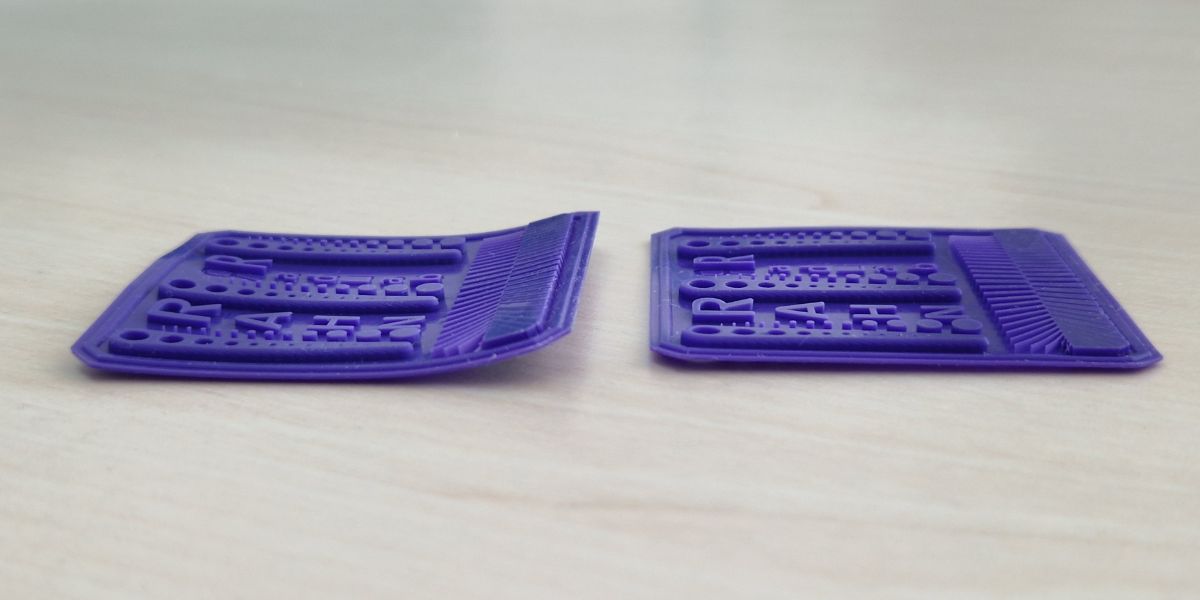
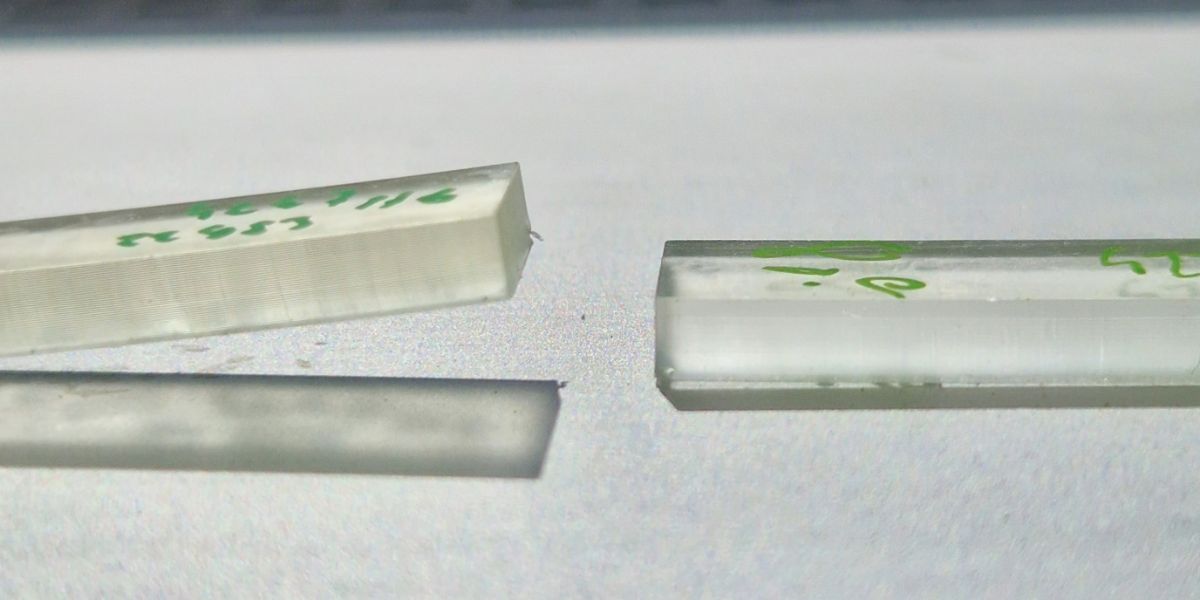
FDM relies on thermal adhesion between layers, which makes some layers weaker or more prone to distortion. SLA creates layers by curing entire regions of resin uniformly for consistent structural integrity. This uniform bonding minimises anisotropic shrinkage, where one direction contracts more than another, and gives SLA parts a more stable dimensional profile and smoother surfaces.
SLA support structures are thin, rigid, and strategically placed to counteract gravitational and curing forces. Because 3D resins cure in a liquid bath, parts remain supported from all sides, which prevents sagging or curling.
This controlled environment ensures that delicate or tall components stay dimensionally accurate throughout printing, unlike FDM, where supports often introduce thermal stresses.
SLA printers operate in enclosed chambers with stable temperatures, minimal airflow, and controlled humidity. These factors reduce environmental stress on the curing resin. In contrast, FDM prints are highly sensitive to drafts, temperature swings, and chamber design, which can drastically affect shrinkage behaviour. Therefore, SLA’s controlled environment ensures reduced 3D printing shrinkage, consistent curing and repeatable results.
While SLA 3D printing shrinkage is lower than FDM, proper process control helps maintain high dimensional accuracy.
Choosing a resin engineered for minimal shrinkage is one of the most effective ways to improve accuracy. 3D printing in dentistry, ceramic resins, and engineering-grade formulations are specifically designed for high precision. Products from the GENOMER* series are widely used in dentistry, jewellery, engineering components, and ceramic burnout applications due to their balanced viscosity, toughness, and extremely low shrink rates.
| GENOMER* 2297 Epoxy (Meth)Acrylates | 3.8% |
| GENOMER* 3143 Polyester / Polyether Acrylates | <1% |
| GENOMER* 4212 Urethane (Meth)Acrylates | 1.1% |
| GENOMER* 4215 Urethane (Meth)Acrylates | 2.9% |
| GENOMER* 4230 Urethane (Meth)Acrylates | <1% |
| GENOMER* 4256 Urethane (Meth)Acrylates | <1% |
| GENOMER* 4267 Urethane (Meth)Acrylates | 2.3% |
| GENOMER* 4270 Urethane (Meth)Acrylates | 3.0% |
| GENOMER* 4277 Urethane (Meth)Acrylates | 3.6% |
| GENOMER* 4365 Epoxy (Meth)Acrylates | 4.4% |
Controlled 3D printing post processing prevents additional shrinkage or deformation caused by uneven heat or overexposure. Timing, intensity, and orientation during post-curing should follow the resin manufacturer’s recommendations. Proper post-curing improves surface hardness, mechanical strength, and chemical resistance while maintaining dimensional accuracy.
RAHN’s advanced low shrinkage 3D resins enable highly predictable results suitable for a wide range of applications. By combining precise materials with controlled printing parameters, manufacturers can achieve superior dimensional accuracy with fewer reprints and faster workflows. Get in touch and book a call with our experts to ensure consistent, high-quality prints every time.
No printing process is completely free of shrinkage. However, careful selection of low-shrinkage resins, proper temperature control, optimised support structures, and post-curing protocols can minimise it to acceptable levels.
Slow-curing or low-shrinkage oligomers will be the first thing to consider. Avoid designing large flat areas whenever possible, segment them, add fillets or lattice structures, and use adequate support structures. Proper slicing and controlled post-curing further reduce deformation.
Yes. SLA shrinkage is chemical rather than thermal, layer bonding is more uniform, supports reduced deformation, and the environment can be controlled.
RAHN AG